The Birth of an Icon: 1886
The Coca-Cola logo story begins in 1886 in Atlanta, Georgia. Frank Mason Robinson, the bookkeeper of Dr. John Pemberton, is credited with both naming the drink and creating its first logo. Robinson chose the flowing Spencerian script that was common in American bookkeeping at the time, giving the brand an elegant, distinctive look from day one.
What makes this origin story remarkable is how little the core design has changed since then. While countless other brands have undergone radical redesigns, Coca-Cola's Spencerian script has remained the brand's visual anchor for over 130 years.
Early Refinements: 1890s to 1940s
Throughout the early decades, the Coca-Cola logo underwent subtle refinements. The script became more standardized, and the distinctive "tail" on the C's was refined for better readability. In 1934, artist Haddon Sundblom created the iconic Santa Claus advertisements that further cemented the brand's visual identity.
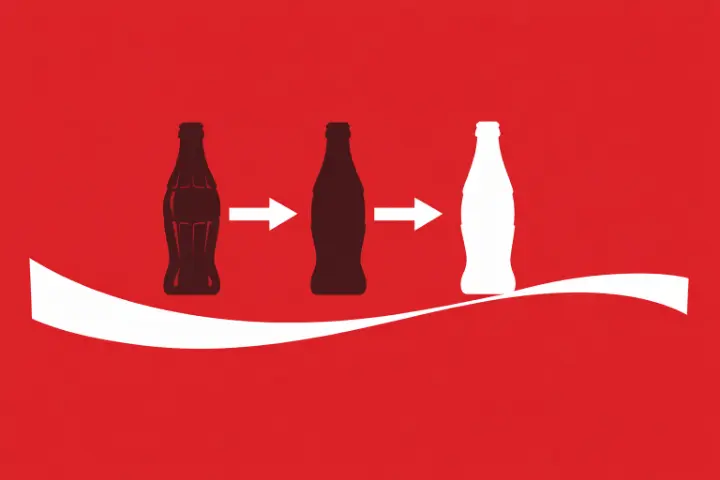
The company also introduced the famous contour bottle in 1915, designed to be recognizable even in the dark or when broken. This attention to visual identity extended well beyond the logo itself, creating a complete brand ecosystem.
Test Your Knowledge!
Think you can identify all these logos? Try Logo Quiz and put your skills to the test.
Play NowThe Dynamic Ribbon: 1969 Onward
In 1969, Coca-Cola introduced the "dynamic ribbon" — a flowing wave that became inseparable from the brand. This addition brought a sense of movement and energy to the logo while maintaining the classic script.
The Arden Square design studio refined the wordmark, and the "wave" or "dynamic ribbon device" was added beneath the script. This element has been adapted and reimagined numerous times, but it has remained a constant companion to the Spencerian lettering.
Through the 1980s and 1990s, the logo saw various treatments — sometimes appearing on a red disc, other times accompanied by the slogan "Enjoy" or "Always." Each iteration kept the core script intact while adapting to contemporary design trends.
Modern Simplicity: 2000s to Today
In recent years, Coca-Cola has embraced minimalism. The 2009 refresh stripped away many embellishments, returning to a cleaner version of the classic script. The "Open Happiness" era brought warm, approachable design language.
The current identity focuses on the timeless script, the iconic red color, and the contour bottle silhouette. There's a lesson here for every brand: sometimes the most powerful design move is restraint.
Lessons From 130 Years of Consistency
Coca-Cola's logo evolution teaches us several important lessons about branding. First, consistency builds equity. By maintaining the core script for over a century, Coca-Cola has built unmatched brand recognition. Second, evolution doesn't mean revolution — subtle refinements can keep a brand fresh without alienating loyal customers.
The Coca-Cola logo proves that great design doesn't need to be reinvented. It needs to be respected, refined, and consistently applied across every touchpoint.
Want to learn more? Check out our games for a fun challenge.